
What is Potential Alcohol?
In the last post, we discussed the effects of temperature on winemaking, and the importance of measuring, monitoring, and regulating temperature during fermentation.
In this article, we will take a look at another important measurement: potential alcohol. When you're done reading this post, you will be able to explain the different units of measurement used to calculate potential alcohol, read a three scale hydrometer correctly, explain the effect of temperature on hydrometer readings, and adjust a hydrometer reading based on temperature.
During fermentation, the yeast has to consume sugar in order to produce alcohol, so when we are measuring potential alcohol we are really concerned with the amount of sugar that is present in the must. In reality, we are measuring and monitoring the sugar levels in our wine and using those measurements to calculate the alcohol levels.
There are two common units of measurement which are used to calculate the level of sugar in wine; specific gravity and Brix.
Specific gravity majors the density of a liquid and compares it to the density of water. The specific gravity of water is 1.0, and this measurement is used as a reference in home winemaking. A liquid that is denser than water will have a higher specific gravity meaning the number will be greater than 1.0. A liquid which is less dense than water will reflect a specific gravity less than 1.0. Specific gravity measurements are stated in one thousandths, or to three decimal points, with the one hundreds, or second decimal point representing 1% of the reading. A specific gravity reading of 1.065, for example, indicates that the solution being measured is 6.5% denser than water.
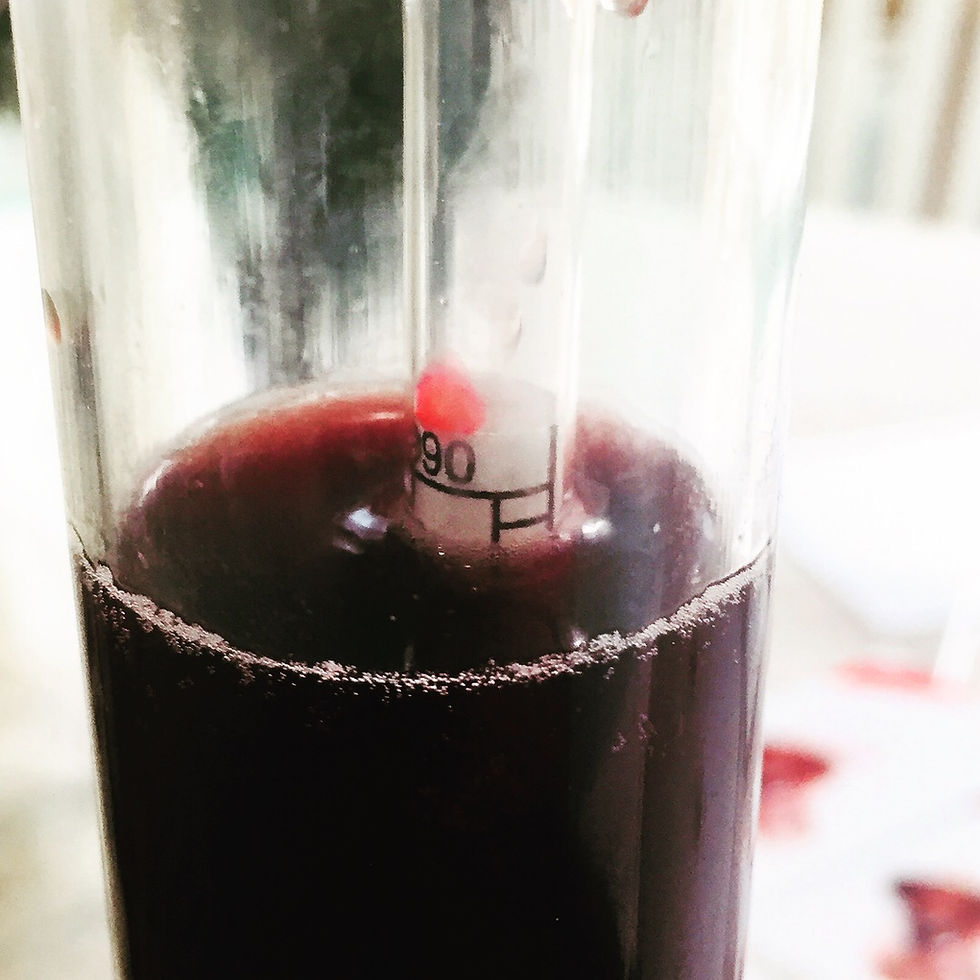
When we start the winemaking process, we take a specific gravity reading before we introduce the yeast to the juice. The specific gravity reading tells us how much sugar is present in the must. Most wines will start at a specific gravity of 1.070 or higher. As fermentation progresses, we will take additional readings to monitor the decreasing levels of sugar in the must. Most wines will ferment out to just below 1.000, sometimes as low as 0.990, which is the lowest reading on the hydrometer. In this example, a wine that starts at 1.090 and ends at 0.990 would finish fermentation at a little bit over 12% alcohol.
The second unit used for measuring sugar levels in the wine is called Brix. Brix is expressed in degrees, similar to temperature, but it represents the percentage of sugar present in a solution. One degree of Brix is equal to 1% sugar in solution. The Brix scale usually ranges from 0 to 30 on a hydrometer. The Brix and specific gravity scales are equivalent to one another, and either one may be used to calculate potential alcohol. A specific gravity of 1.095 is equal to 22.5° Brix, meaning there is 22.5% sugar in the must.
The most common tool used to measure sugar levels in winemaking is the hydrometer. Most hydrometers are equipped with three scales; specific gravity, Brix, and percentage of potential alcohol by volume. By taking one reading using the hydrometer, you can record the three measurements simultaneously.
Using a hydrometer is fairly simple, but you need to pay attention to a few details. Use a sanitized wine thief to transfer enough liquid to a sanitized hydrometer test jar to fill it about halfway. Insert the sanitized hydrometer into the test jar and spin it so it doesn't cling to the sides of the jar and give you a false reading.
To read the hydrometer, look at the liquid level in the test jar. the liquid will be slightly raised where it touches the inside wall of the test jar and the outside of the hydrometer. Take your hydrometer reading from the point on the scale that is even with the lowest point of the liquid level. Record this value and set it aside for later.
If your hydrometer has a thermometer in it, record the temperature of the juice. If not, remove the hydrometer from the test jar and insert a sanitized floating thermometer. Wait about one minute for the temperature to normalize, then remove the thermometer and record the temperature of your must.
Most hydrometers used in winemaking are calibrated to 68°F or 20°C, meaning the hydrometer reading is accurate at that temperature and does not need to be adjusted. It is important to know the calibration temperature of your hydrometer. To determine the calibration temperature for your hydrometer look at the scale and find the calibration temperature.
At this point, let's talk a little bit about the effect of temperature on specific gravity. When a liquid is warm, it is less dense because the heat speeds up the activity in the molecules and causes them to move away from each other. On the other hand, the cooler the liquid is, the slower the molecules move, and the closer together they become. So a warm liquid is less dense, meaning the specific gravity reading will be lower than the true specific gravity. If the liquid is excessively cold, it will produce a specific gravity reading which is higher than the actual specific gravity, because the molecules are closer together, which creates a false impression that the liquid is more dense than it really is.
To compensate for the effect of temperature on specific gravity, we have to do some simple math.
In the resources links below, you will find a chart which can be used to adjust your specific gravity using a hydrometer calibrated to 68°F or 20°C. These charts are widely available on the Internet, as well as some automated calculators offered by home brewing and winemaking web sites. I prefer to use the chart, because some online calculators are not properly programmed to produce a correct adjustment.
To use the chart, find the temperature of your must, and locate the corresponding adjustment number. If the number is negative, subtract that number from your specific gravity reading. If the number is positive, add that number to your specific gravity reading. The final answer to this simple math problem is the true specific gravity reading.
As an example, if your specific gravity reading is 1.098, and the temperature of your must is 76°F (25.6°C), you will add 0.0012 to your specific gravity, making your actual reading 1.099. Using the metric equivalent, a specific gravity reading of 1.100 at 30°C would require you to add 0.0022 your reading, which results in a final specific gravity calculation of 1.102.
This adjustment for temperature should be calculated any time you take a specific gravity reading where the temperature is higher or lower than your hydrometer's calibration temperature.
Measuring and calculating potential alcohol is a relatively simple process, and with a little practice it will become a natural and consistent habit in your winemaking practice. In the next post, I'll be discussing how specific gravity can be used to determine when fermentation is finished.
If you have additional questions about specific gravity, Brix, or the calculations discussed in this article, be sure to post them in the comments below, send me an email, or DM me on Instagram.
Comments